


AI is working behind almost every social media experience. It helps platforms rank feeds, detect harmful content, recommend videos, power chat assistants, and give businesses new ways to manage customer interactions. Here is what it does, what it means for users, and how brands can use it responsibly.
Key takeaways
- AI on social media includes platform algorithms as well as tools used by creators and businesses.
- Common uses include feed ranking, content moderation, content creation, chat assistance, and advertising.
- AI can save time, but people should review important content and customer conversations.
- Clear disclosure matters when AI-generated or manipulated content could mislead an audience.
- Businesses should choose tools that use authorized platform integrations and follow each network’s rules.
What is AI on social media?
AI on social media refers to technologies that analyze information, recognize patterns, make predictions, and generate or assist with content across social platforms. Some AI is built directly into apps. Other AI comes from tools that creators, marketers, and businesses use to plan content or respond to customers.
For example, an app may use AI to decide which videos appear in your feed. It may also detect spam, recommend accounts, or label content that appears to be AI-generated. A business might use a separate tool to schedule posts, organize messages, or send an automatic reply when someone comments with a specific keyword.
These examples are related, but they are not the same thing. A social platform’s recommendation algorithm is different from a business automation workflow. Understanding that distinction makes it easier to choose the right tools and set realistic expectations.
How is AI used on social media?
Most social media AI activity fits into five broad categories.
| Use | What AI does | Everyday example |
| Feed ranking | Predicts which posts may be relevant to each person and orders the feed. | Recommended Reels, videos, posts, and suggested accounts. |
| Content moderation | Identifies possible spam, scams, abusive content, or policy violations for further action. | Spam detection, content warnings, and removed posts. |
| Content creation | Helps generate or edit text, images, audio, and video. | Caption drafts, image variations, subtitles, and editing tools. |
| Chat assistance | Responds to questions or helps users complete tasks through conversational interfaces. | In-app assistants and business messaging automation. |
| Advertising | Helps advertisers find audiences, optimize delivery, and create ad variations. | Audience prediction and automated creative suggestions. |
How does AI decide what appears in your feed?
Social platforms use recommendation systems to estimate which content a person may find useful or interesting. These systems can consider many signals, such as the accounts someone follows, the videos they watch, how long they watch, what they like or share, and whether they interact with similar content.
The exact signals and their importance vary by platform and can change over time. There is no single universal algorithm, and a platform’s ranking system is not simply a list of fixed rules that creators can follow to guarantee reach.
For businesses and creators, the practical lesson is to publish content that is relevant to a real audience. Make the subject clear, deliver the value promised by the opening, encourage genuine discussion, and review platform analytics to understand what your audience responds to. Avoid relying on tricks such as engagement bait or repetitive reposting.
How does AI help moderate social media content?
Platforms use automated systems to identify content that may violate their policies. These systems can scan posts, comments, images, videos, and account activity for patterns associated with spam or other prohibited behavior. Depending on the platform and the type of content, a system may take action automatically or send a case to human reviewers.
Automation helps platforms review large volumes of activity, but it is not perfect. Context, satire, language differences, and fast-changing events can make content difficult to assess. Users and businesses should understand the platform’s rules and use its appeal process if they believe a moderation decision is incorrect.
For businesses, the lesson is straightforward: avoid tools or tactics that create repetitive, unsolicited activity. Use authorized integrations, respect messaging limits, and make sure automated replies are relevant to the person who triggered them.
What is AI-generated content on social media?
AI-generated content is text, images, audio, or video created wholly or partly with generative AI. It can include a caption drafted by an AI assistant, an image created from a prompt, a synthetic voice-over, or a video in which a real person appears to say or do something they never did.
Generative tools can help teams brainstorm and produce first drafts more quickly. They can also introduce errors, stereotypes, misleading visuals, or wording that does not match a brand’s voice. A human review is important before publishing, especially when a post includes factual claims, product details, prices, health or financial information, or statements about real people.
How do platforms label AI-generated content?
Labeling approaches differ across platforms and may depend on creator disclosure, technical signals, or the type of editing used. Meta has described its approach to labeling AI-generated content and manipulated media in its AI labeling policy update. TikTok explains when creators must label realistic AI-generated images, audio, and video in its AI-generated content guidance.
Do not assume that the absence of a label proves a post was made without AI. Labels and detection methods have limitations, and technical information can be lost when files are downloaded, edited, or re-uploaded. When authenticity matters, check the original source and look for supporting context.
What are AI assistants on social media?
AI assistants are conversational tools that can answer questions, generate ideas, summarize information, or help users complete tasks. Some are built into social platforms. Others are provided by third-party services and connected to business accounts.
For businesses, messaging automation can help handle predictable interactions. For example, a workflow might send a welcome message, provide an approved FAQ answer, share a link after a keyword comment, or direct a conversation to a team member. These are workflow-based automations; they should not automatically be described as AI unless the product actually uses AI to generate or interpret responses.
That distinction matters. A rule-based automation follows conditions configured by the business. An AI assistant may interpret a broader question and generate a response. Both can be useful, but they need different levels of testing, oversight, and customer disclosure.
How can businesses use AI and automation on social media?
Businesses can use AI-assisted and automation tools to reduce repetitive work, keep publishing organized, and respond to common interactions more consistently. The best starting point is a specific task that takes time and has a clear, repeatable process.
- Plan and draft content. Use AI to brainstorm topics, outline posts, or prepare caption drafts. Check every draft for accuracy, originality, tone, and relevance before publishing.
- Schedule posts. Use a social media management tool to prepare content in advance and organize publishing across connected accounts. Confirm that the tool supports the platforms and post formats you need.
- Respond to routine interactions. Set up approved replies for common questions or keyword-based triggers. Keep the wording clear and make it easy for a customer to reach a person.
- Organize conversations. Use an inbox or contact-management workflow to keep track of messages and follow-ups. Assign sensitive or complicated questions to a human team member.
- Review performance. Use platform insights and reporting tools to identify which content earns meaningful engagement, clicks, or enquiries. Treat the numbers as evidence to investigate, not as a guarantee of future results.
What are the benefits and risks of AI on social media?
Potential benefits
- Time savings: AI-assisted drafting and repeatable workflows can reduce manual work.
- More organized publishing: Scheduling tools help teams plan content instead of posting everything at the last minute.
- Faster routine responses: Automated replies can acknowledge common questions when configured correctly.
- Useful insights: Analytics can help teams understand audience behavior and improve future content.
- More consistent processes: Shared templates and workflows can make it easier for teams to follow approved messaging.
Risks to manage
- Incorrect information: AI-generated text can sound confident while being wrong. Verify facts, links, prices, and product details.
- Loss of personal tone: Generic or repetitive replies can frustrate customers. Review templates and personalize conversations when needed.
- Privacy concerns: Do not enter customer or confidential business information into AI services unless the service and your use of it are appropriate for that data.
- Platform restrictions: Unapproved bots, spam-like activity, or excessive messaging can put accounts at risk. Follow each platform’s current policies and technical limits.
- Over-automation: Complaints, sensitive issues, and unusual requests often need human judgment.
What do people think about AI on social media?
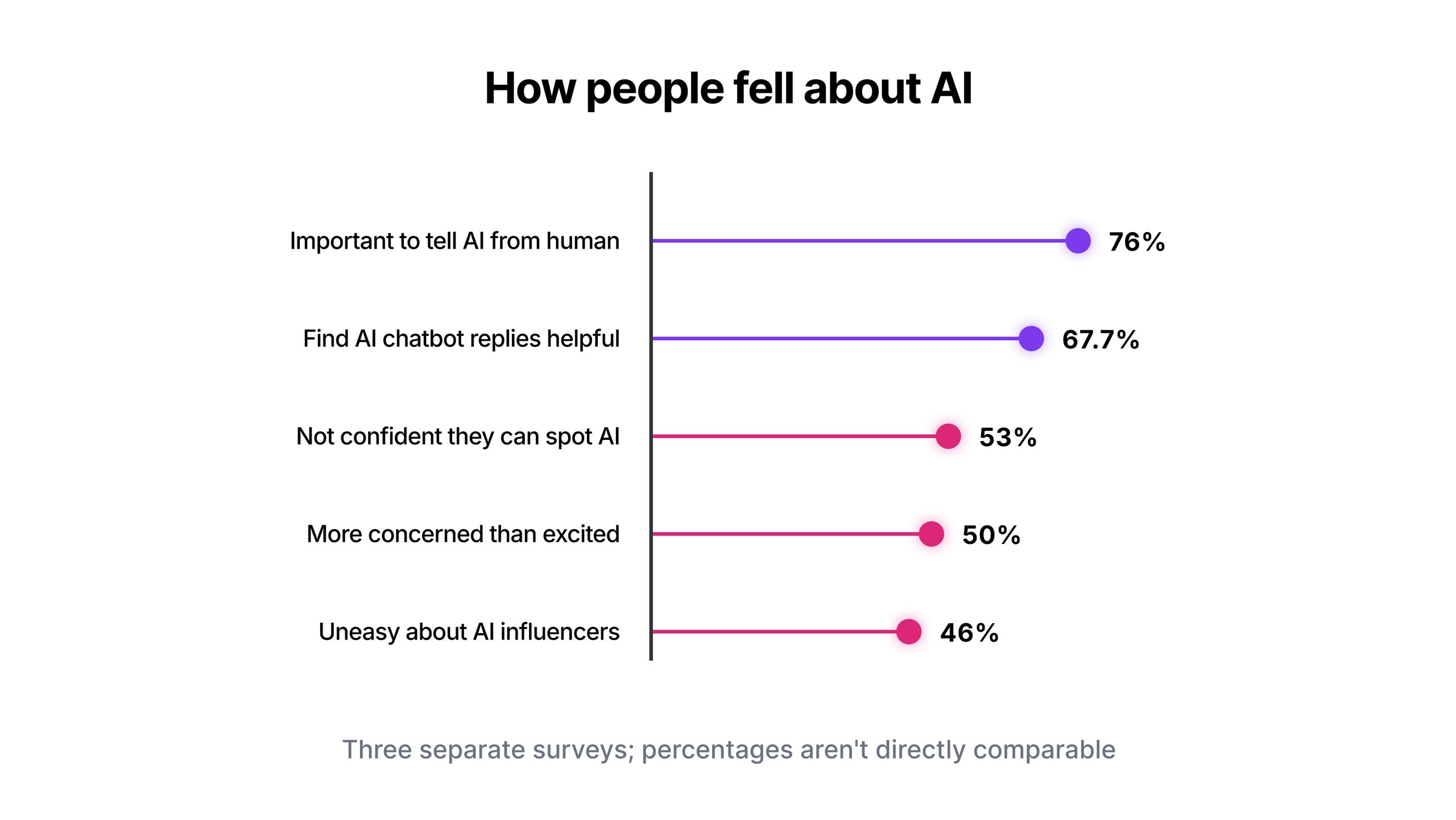
People can appreciate useful AI features while still wanting transparency about how AI is used. In a 2025 Pew Research Center survey, 76% of U.S. adults said it was extremely or very important to be able to tell whether pictures, videos, and text were made by AI or by people. The same research found that 53% were not too or not at all confident that they could identify AI-made content.
These findings point to a practical standard for brands: use AI to support the work, but do not mislead people about who or what they are interacting with. Make automated experiences clear, check generated content, and keep a real person available when the situation calls for judgment.
What rules apply to AI on social media in 2026?
Rules depend on where a business operates, what the AI system does, and the type of content or interaction involved. Platform policies, advertising standards, privacy laws, and consumer-protection rules may all apply.
In the European Union, the transparency obligations in Article 50 of the AI Act apply from 2 August 2026. They cover several situations, including informing people when they interact directly with certain AI systems and disclosing certain deepfakes or AI-generated public-interest text. The precise obligation depends on the role of the provider or deployer and the type of system or content. The European Commission also describes a limited transition for certain marking obligations involving systems placed on the market before that date, with compliance due from 2 December 2026.
This is a general overview, not legal advice. Businesses should consult the official European Commission Article 50 FAQ and obtain qualified advice for their own use case. They should also check the latest rules of every social platform they use.
How should a brand use AI responsibly?
A practical approach is to automate predictable tasks and keep human judgment in the loop. Before enabling a workflow, decide what should trigger it, what information it may send, and when it should stop and hand the conversation to a person.
- Use AI for support, not blind approval. Review captions, creative assets, claims, and customer-facing answers before they go live.
- Be transparent. Follow applicable disclosure rules and do not present an automated assistant as a human employee.
- Protect customer information. Collect only what is needed and use services that are suitable for the data involved.
- Respect platform rules. Prefer official integrations and approved publishing or messaging methods.
- Keep an escalation path. Send complaints, account issues, payment questions, and unusual requests to a human.
- Measure useful outcomes. Track response quality, customer satisfaction, qualified enquiries, and time saved—not just the number of automated messages.
Where does AutoPubliX fit in?
AutoPubliX is a social media management and automation platform for organizing publishing and handling repeatable interactions on supported social accounts. Its documented features include creating and scheduling posts, managing published and scheduled content, setting up Instagram and Facebook DM automations, triggering workflows from post or Reel comments, responding to story replies, and managing Instagram conversations in an inbox.
These workflows are useful when a business wants to send an approved response, share a link, answer a frequently asked question, or keep a conversation organized. They are configured automations; this article does not claim that every workflow uses generative AI. Availability can depend on the connected platform, account permissions, and subscription plan, so check the current product documentation before choosing a workflow.
Explore the AutoPubliX automation features or review the available plans to see whether the platform fits your publishing and engagement process.
Frequently asked questions
What does AI mean on social media?
It refers to technologies that analyze content and behavior, make predictions, and generate or assist with content. Social platforms use AI for tasks such as feed ranking and moderation, while creators and businesses use AI tools for drafting, editing, analytics, and customer interactions.
Do social media algorithms use AI?
Many major social platforms use machine-learning recommendation systems to rank and suggest content. The signals and methods vary by platform and change over time, so there is no single formula that guarantees reach.
Can AI create social media posts?
Yes. Generative AI tools can help draft captions, create images, produce video assets, and suggest content ideas. Review all output for accuracy, originality, brand fit, rights, and disclosure requirements before publishing.
Is AI automation the same as an AI chatbot?
No. Rule-based automation follows conditions and actions configured by a user, such as sending a reply after a keyword comment. An AI chatbot can interpret a wider range of messages and generate responses. Some products offer one, the other, or a combination.
Is it safe to automate social media messages?
It can be appropriate when the tool uses authorized integrations, follows the platform’s policies and messaging limits, and sends relevant messages to people who have initiated or otherwise permitted the interaction. Avoid spam-like behavior and provide a way to reach a human.
Should businesses use AI on social media?
Businesses can benefit when AI supports a clear process, such as drafting content or analyzing performance. Start with low-risk tasks, verify generated information, protect customer data, and keep people responsible for important decisions and sensitive conversations.
Conclusion
AI on social media is more than a tool for generating captions or images. It helps platforms rank content, detect potential policy violations, recommend videos, power assistants, and deliver advertising. Businesses can also use AI-assisted tools and automation to plan content and manage routine interactions.
The strongest approach is balanced: use technology to reduce repetitive work, check what it produces, respect platform rules, and keep people involved where trust and judgment matter. That is how social media automation can support a better customer experience without replacing the human side of your brand.
Make social media work more manageable
Explore how AutoPubliX can help organize scheduled posts and repeatable Instagram and Facebook engagement workflows.
Explore More Blogs: https://blog.autopublix.com/

