


Because customers now expect to message a brand, and most brands can’t answer in time. In a 2025 Kantar survey for Meta, 73.3% of consumers said they prefer messaging when contacting a business (WhatsApp Business, State of Business Messaging). Yet in 2024, brands answered about 7% of their social messages and comments each day (Sprout Social).
DM automation closes that gap. This post covers the business case: what customers expect, what slow replies cost, and where automation helps or hurts. If you want the setup steps instead, read our Instagram DM automation guide.
Why is DM automation important for brands?
It lets a brand answer every message within minutes, at a volume no team can match by hand. In 2025, Meta CEO Mark Zuckerberg said people have “more than 1 billion active threads with business accounts” across Meta’s messaging apps every day (Meta, Q3 2025 earnings call). That’s where buying questions now happen.
The case for automation comes down to five things:
- Customers prefer it. Most people would rather message than call or email.
- Volume keeps rising. Inboxes are growing faster than social teams.
- Speed decides the sale. A slow reply sends buyers to a competitor.
- Meta’s rules reward speed. Automated replies only work inside a 24-hour window.
- It turns attention into leads. A comment or story reply can become a conversation in seconds.
The rest of this post takes each one in turn, with the data behind it.
Do customers really want to message brands?
Yes, and by a wide margin. Meta commissioned Kantar to survey 11,056 adults in 22 markets between April and September 2025. In that study, 73.3% of consumers said they prefer messaging a business, and 72.4% said they’re more likely to buy from a brand that offers it (WhatsApp Business, 2026 Consumer Report).
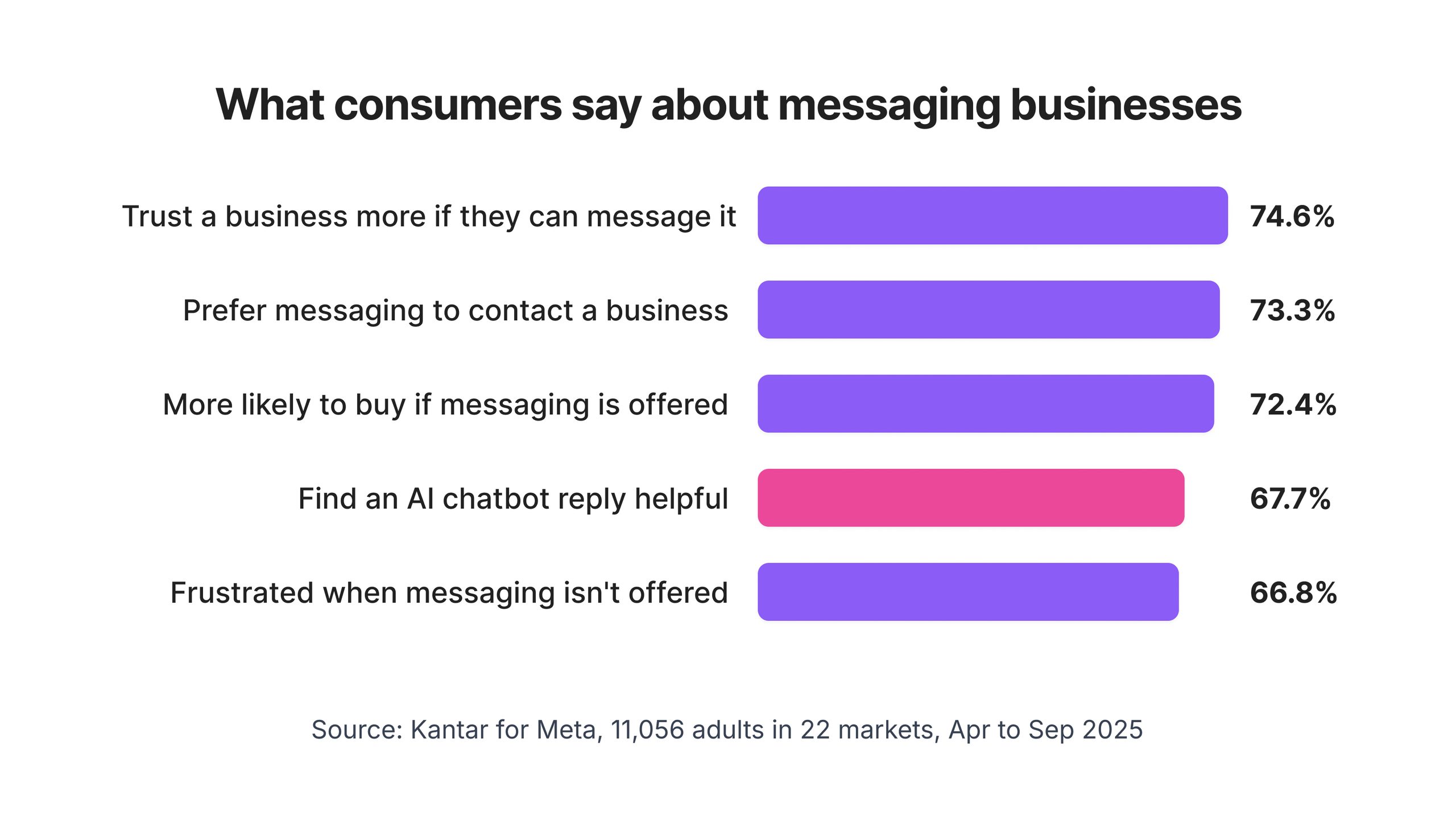
Roughly three in four consumers prefer, trust and buy more from brands they can message. Source: WhatsApp Business, State of Business Messaging (Kantar, commissioned by Meta).
Keep in mind who paid for it. Meta sells business messaging, so it has a reason to publish these numbers. Still, independent data points the same way. Sprout Social’s 2025 Content Benchmarks found that the average Instagram business account went from 13 to 18 incoming messages a day between 2023 and 2024 (Sprout Social, Social media customer service statistics).
Instagram is leaning in too. When it reached 3 billion monthly users in September 2025, Instagram head Adam Mosseri said “almost all of our growth has been driven by DMs, Reels, and recommendations” (MediaPost). When the platform itself is built around messaging, a brand that doesn’t answer messages is missing where its customers are.
Why can’t brands keep up with DMs by hand?
Because message volume is growing faster than teams are. In Sprout Social’s 2025 Content Benchmarks Report, Instagram’s incoming messages rose 38% in a year, from 13 to 18 a day. Over the same period, the daily response rate to social messages and comments slipped from 8% to 7% across networks (Sprout Social).
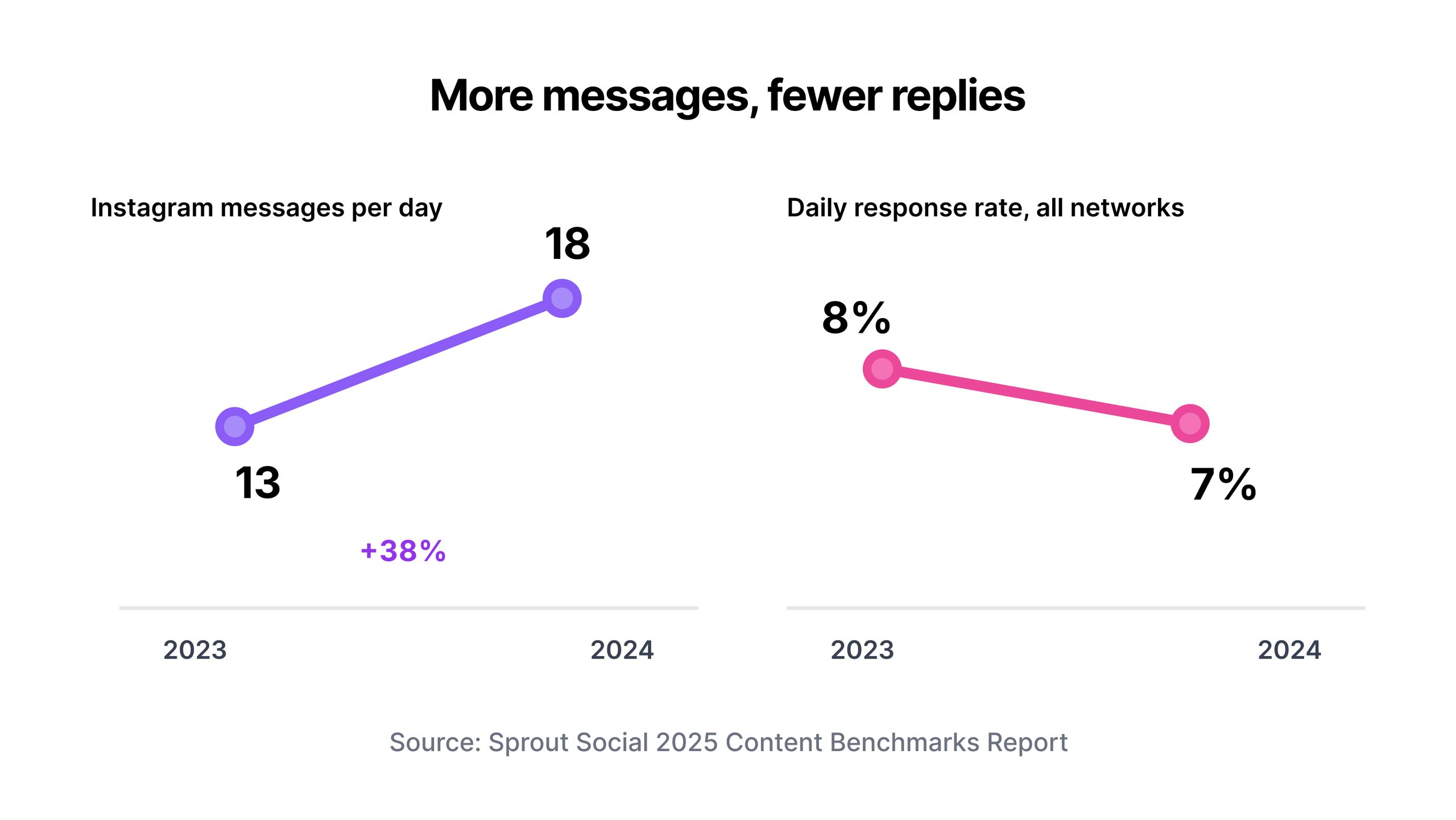
Instagram inboxes got 38% busier in a year while response rates went down. Source: Sprout Social, 2025 Content Benchmarks Report.
That gap isn’t about effort. Most DMs arrive in bursts: after a reel takes off, during a sale, or at 11 p.m. when someone finally has time to ask. A team that works 9 to 6 can be fully staffed and still miss the peak. Notice what kind of messages pile up, too. They’re mostly the same few questions about price, sizes, shipping, links and opening hours.
Those repeat questions are what automation should take. Once they’re answered instantly, people can spend their time on the messages that need judgment. For examples of common flows, see our Instagram DM automation workflows.
What does a slow reply actually cost?
Sales first, and then the right to reply at all. According to the 2025 Sprout Social Index, about three-quarters of consumers expect a brand to respond on social within 24 hours, and 73% say they’ll buy from a competitor if a brand doesn’t respond (Sprout Social).
The second cost gets less attention. Meta’s messaging policy only allows automated replies in a standard window that, “for most user actions, it lasts 24 hours” after the person’s last message (Meta for Developers, Messenger Platform and IG Messaging API policy). After that, automation can’t follow up. Only a person can, using the Human Agent tag, for up to 7 days.
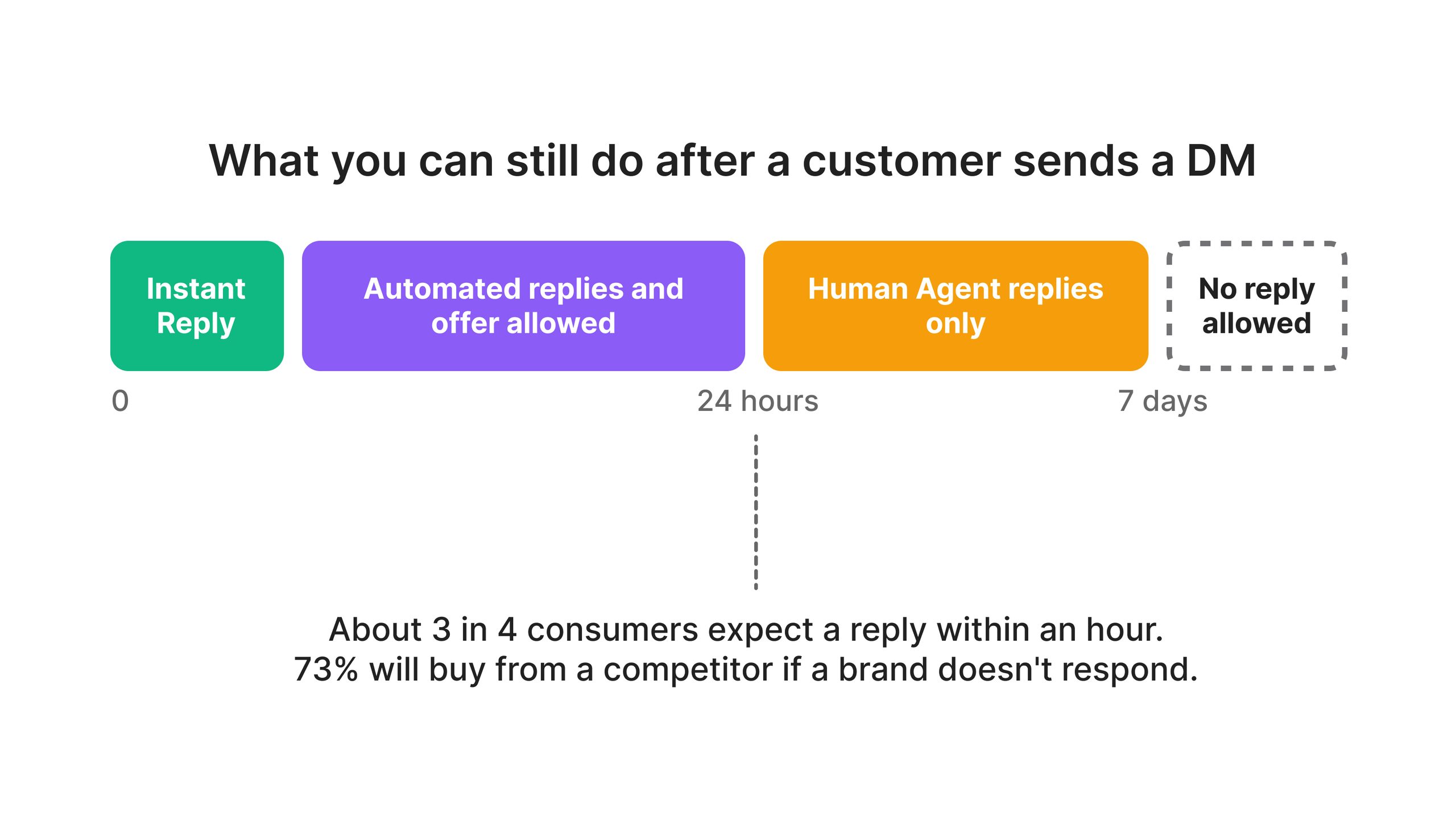
Customer patience and Meta’s rules run on the same clock. Miss the first 24 hours and you lose both the sale and automated follow-up. Sources: Meta for Developers, Sprout Social.
So on Instagram and Messenger, response time isn’t only a service metric. It decides which tools you’re still allowed to use. A brand that answers in seconds can send the price, the link and a follow-up question while the buyer is still interested. A brand that answers on day two can only send manual replies, and the buyer may have bought elsewhere by then.
How does DM automation turn attention into sales?
It starts a private conversation at the moment someone shows interest. In 2026, Buffer analyzed nearly 2 million posts and found that replying to comments was linked to 21% higher engagement on Instagram (Buffer, The State of Social Media Engagement in 2026). Comment-to-DM automation does both jobs at once.
Here’s how it usually works. A reel says “comment PRICE and we’ll send the details.” Each comment triggers one private reply with the link, which Meta allows within 7 days of the comment (Meta for Developers, Private Replies). The comment section grows, which helps the post. And the buyer gets the information in a channel where you can keep talking.
The same idea works for:
- Story replies. Someone reacts to a product story and gets the link straight away. See our guide to Instagram story reply automation.
- Ads. Click-to-message ads open a chat instead of a landing page.
- New followers and inquiries. A short welcome message that asks what they’re looking for.
Advertisers are moving the same way. On Meta’s Q4 2025 earnings call, CFO Susan Li said click-to-message ad revenue in the US grew more than 50% year over year, and WhatsApp paid messaging crossed a $2 billion annual run-rate (Meta, Q4 2025 earnings call). Those ads only pay off if someone answers the chat they open.
For a step-by-step setup, see the comment-to-DM automation beginner’s guide.
Does DM automation make a brand feel less human?
Not if it’s honest and knows when to step aside. In the 2025 Kantar study for Meta, 67.7% of consumers said a response from an AI chatbot is helpful. In Sprout Social’s Q4 2025 Pulse Survey, 69% said they’re comfortable with brands using AI to deliver faster care (Sprout Social).
What puts people off isn’t the automation. It’s being stuck with it. A bot that loops, ignores the question or pretends to be a person does more harm than a slow human reply. The same Kantar study found 79.3% of consumers want proof a business is legitimate before engaging, which is a good reason to say up front that a reply is automated.
Three habits keep automation feeling human:
- Say it’s automated. One line in the first message is enough.
- Offer a way out. A keyword like HUMAN that pauses the bot and alerts your team.
- Write like your brand talks. Short, specific and in your usual tone.
Our guide on automating Instagram DMs without breaking Meta’s rules has templates for each of these.
What should brands automate, and what shouldn’t they?
Automate the predictable and keep the sensitive for people. With about 18 messages a day landing in the average Instagram business inbox in 2024, by Sprout Social’s count, most of the volume is the same handful of questions. A rough split:
| Automate | Keep human |
|---|---|
| First reply and acknowledgement | Complaints and refunds |
| Prices, sizes, stock and shipping times | Anything involving health, money or legal advice |
| Links from comment keywords and story replies | Custom quotes and large orders |
| Opening hours, location and booking links | Influencer and partnership pitches |
| Lead questions (name, need, budget) | Angry or upset customers |
| Routing to the right team member | The final “yes” on a big sale |
Two things never belong in automation. The first is cold outreach. Meta only allows messages to people who contacted you first. The second is bulk follows or likes to “warm up” prospects, which is bot behavior. Our post on Instagram bots vs automation explains where that line is and why it matters for account safety. For a broader view, see is Instagram automation safe?
How do you know DM automation is working?
Track speed, coverage and outcomes, not just message counts. The benchmark to beat is low: Sprout Social’s 2025 data puts the daily response rate across social networks at about 7% (Sprout Social). Four numbers tell you most of what you need:
- Median first-response time. Aim for under a minute on automated flows and under a few hours for handoffs.
- Share of messages answered within 24 hours. This should be close to 100%. Anything else falls outside Meta’s automation window.
- Handoff rate. If more than a third of conversations need a person, your flows are missing common questions.
- Conversions from DMs. Clicks, bookings or orders from tracked links in your replies.
Review the flows monthly. Products change, prices change, and a bot quoting last season’s offer does more damage than no bot at all.
How AutoPubliX fits in
AutoPubliX connects to Instagram and Facebook through Meta’s official API and handles comment-to-DM replies, story replies, keyword triggers and lead capture, with a handoff to your team when a person is needed. It also schedules posts, so the post and the replies it brings in are set up together. See how Instagram automation works in AutoPubliX or start a 14-day free trial.
Frequently Asked Questions
Why is DM automation important for small brands?
Small teams feel the volume gap most. Sprout Social found Instagram business inboxes grew from 13 to 18 messages a day between 2023 and 2024. A founder answering between other jobs can’t reply in seconds. Automation answers routine questions instantly and saves the owner’s time for sales and complaints.
Does DM automation increase sales?
It can, mainly by stopping lost sales. In the 2025 Sprout Social Index, 73% of social users said they’d buy from a competitor if a brand didn’t respond. Automation answers within seconds, while the buyer is still interested, and sends the product link in the same conversation.
Is DM automation allowed on Instagram?
Yes, through Meta’s official API and only for people who message or comment first. Meta allows automated replies within 24 hours of a person’s last message, and one private reply per comment within 7 days. Cold DMs and bulk follows aren’t allowed. See is Instagram automation safe?
Will customers be annoyed by automated replies?
Most won’t, if replies are useful and honest. In Sprout Social’s Q4 2025 survey, 69% of consumers said they’re comfortable with brands using AI for faster care. Annoyance comes from bots that loop or hide that they’re automated. Disclose it and offer a quick route to a person.
Which channels should a brand automate first?
Start where most messages arrive. For most consumer brands that’s Instagram, where Mosseri said in 2025 that DMs drive most of the app’s growth. Facebook Messenger and WhatsApp follow. Our Messenger vs Instagram DM automation comparison helps you choose.
Conclusion
DM automation matters because customers have moved into the inbox faster than brands have. About 73% of consumers prefer to message a business, Instagram inboxes got 38% busier in a year, and Meta’s 24-hour window turns slow replies into missed sales.
- Automate the first reply and the questions you answer every day.
- Keep complaints, refunds and big decisions with a person.
- Measure first-response time and the share of messages answered within 24 hours.
Ready to set it up? Start with our Instagram DM automation guide.

