


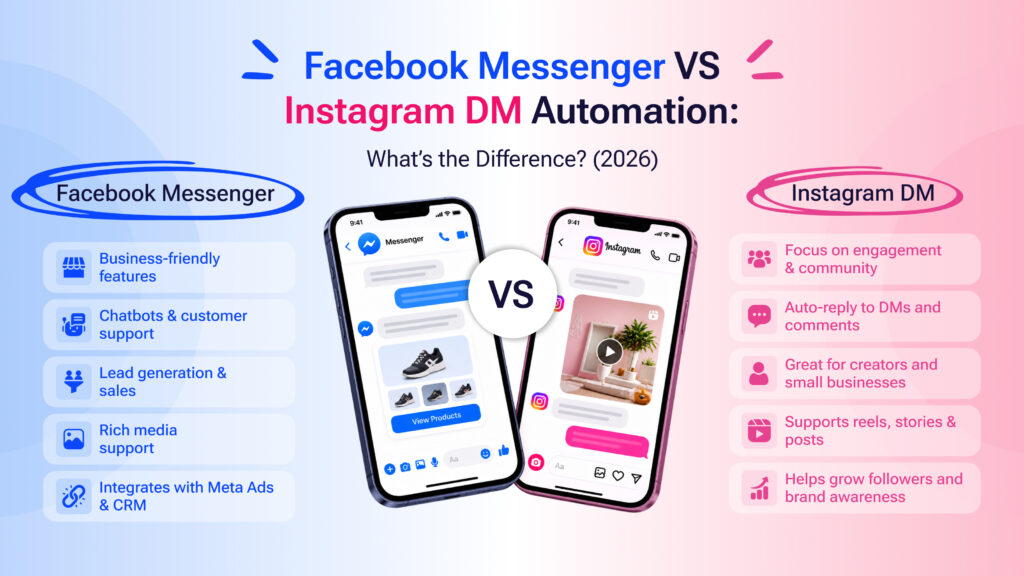
Since Meta owns both platforms, it’s a reasonable assumption that automating Messenger and automating Instagram DMs are basically the same thing with a different logo on top. They’re not — the audiences behave differently, the technical integration has real differences, and the content patterns that trigger automation look different on each platform. This guide breaks down exactly what’s different, what overlaps, and how to decide where to focus first if you’re not running both.
The Short Answer
Facebook Messenger automation and Instagram DM automation both run through Meta’s Messenger Platform API, which means the underlying technical foundation is shared — a tool built on Meta’s official API can often support both with the same core infrastructure. What differs is audience behavior, how conversations typically start (comments vs. direct messages vs. ads), and the content/tone patterns that work on each platform.
If you’re choosing where to focus first: match the platform to where your actual audience and current engagement already is, not which one seems technically easier to automate.
How the Platforms Actually Differ
Audience and typical use case. Facebook Messenger automation skews toward customer service and support conversations — order status, appointment booking, FAQ handling — often initiated from a Facebook Page or an ad. Instagram DM automation skews more toward engagement-driven conversations — comment-to-DM triggers, influencer and creator interactions, and younger or more visually-driven audiences discovering a brand through content rather than a direct search.
How conversations typically start. On Instagram, a huge share of automated conversations begin with comment-to-DM: someone comments a keyword on a post or Reel, and that triggers the automated message. Facebook Messenger conversations more often start directly — someone messages a Page, clicks a “Send Message” button on an ad, or continues from a previous interaction. This difference shapes what kind of automation actually matters most on each platform.
Content and tone expectations. Instagram’s casual, visual-first culture means automated replies that feel overly formal stand out more than on Facebook, where a slightly more structured, business-like tone fits audience expectations better, particularly for support-oriented interactions.
Discovery versus direct intent. Instagram DMs often come from someone discovering a brand through a Reel or post and commenting out of interest — automation here is capturing and converting fresh interest. Facebook Messenger messages more often come from someone who already knows what they want (a support question, an order issue) — automation here is about fast, accurate resolution rather than conversion.
What’s Actually the Same
The underlying API infrastructure. Both run through Meta’s Messenger Platform, meaning official, compliant automation tools can generally support both without rebuilding the core technical integration from scratch.
The compliance requirements. The same core rule applies to both — automation needs to connect through Meta’s official API with proper authorization, not password-sharing or unofficial access methods. See is Instagram automation safe for the full breakdown, which applies equally to Messenger.
The basic automation building blocks. Keyword triggers, welcome messages, fallback handling for unmatched messages, and human handoff for conversations that need real judgment — these concepts work the same way on both platforms, even though the specific triggers and content differ.
The core risk of generic, obviously-scripted replies. Both platforms penalize automation that feels robotic in the same way — audiences on either platform respond better to replies with real variation and natural tone than to a single repeated template.
Facebook Messenger Automation: What It’s Best At
Customer service and support flows. Order status checks, appointment scheduling, and FAQ handling are where Messenger automation tends to deliver the clearest value — structured, predictable interactions that benefit from fast, consistent automated responses.
Ad-driven conversations. “Click to Messenger” ads are a common Facebook ad format specifically designed to start a Messenger conversation — automation here handles the immediate follow-up the moment someone clicks, before interest fades.
Longer-form, detail-heavy interactions. Facebook’s audience and interface lean toward slightly longer, more detailed exchanges compared to Instagram’s faster, more visual interaction style — useful for conversations requiring more information exchange.
See the full guide to Facebook Messenger automation for small businesses for setup specifics.
Instagram DM Automation: What It’s Best At
Comment-to-DM lead capture. This is Instagram’s signature automation pattern — someone comments “price” or “link” on a post, and an automated DM delivers the details privately. See the full Instagram DM automation guide and comment automation guide for how this works.
Content-driven engagement. Automation triggered by Reels and post engagement, catching interest at the exact moment it’s generated by content, rather than waiting for someone to proactively message.
Creator and influencer-style interactions. Instagram’s audience expectations around personality and casual tone make it a strong fit for brands whose Instagram presence leans into creator-style content and community engagement.
Comparison Table
| Facebook Messenger Automation | Instagram DM Automation | |
|---|---|---|
| Typical trigger | Direct message, ad click | Comment-to-DM, post/Reel engagement |
| Primary use case | Customer service, support | Lead capture, engagement conversion |
| Tone expectation | Slightly more structured | Casual, personality-driven |
| Common entry point | Facebook Page, ads | Comments, Reels, Stories |
| Technical foundation | Meta Messenger Platform API | Meta Messenger Platform API |
| Compliance rules | Official API, OAuth required | Official API, OAuth required |
Should You Automate Both?
For most businesses active on both platforms, the answer is yes — but not necessarily at the same time or with equal priority. A few ways to think about sequencing:
If your audience and engagement clearly lean toward one platform, start there. A business with strong Instagram engagement but minimal Facebook Page activity gets more value from Instagram automation first, and vice versa.
If you’re running Facebook ads with a “Click to Messenger” objective, Messenger automation has an immediate, clear use case tied directly to ad spend — worth prioritizing alongside or ahead of Instagram if that’s an active ad strategy.
If your growth strategy centers on content and Reels, Instagram’s comment-to-DM pattern is where the bulk of your automatable engagement volume will come from.
If support volume is your actual bottleneck (not engagement or lead capture), Messenger’s structured, support-oriented strengths likely matter more than Instagram’s engagement-driven pattern.
Running Both From One Tool
Since both platforms share the same underlying Meta API infrastructure, a tool built to handle one often extends to the other without requiring an entirely separate system — worth checking directly with any platform you’re evaluating. AutoPubliX is built Instagram-first specifically, with its deepest feature set around Instagram’s comment-to-DM pattern and content scheduling; confirm current Messenger-specific capabilities directly if Facebook support automation is an equally important priority for your business, since platform-specific depth varies by provider and changes over time.
Metrics That Matter Differently on Each Platform
Measuring success looks different depending on which platform’s automation you’re evaluating, and conflating the two can lead to the wrong conclusions:
For Instagram DM automation, the metrics that matter most are typically trigger-to-conversation rate (how many comment triggers turn into an actual DM exchange) and lead-tag distribution (what people are actually asking about, which shapes future content and offers). Raw message volume matters less than conversion from initial interest to real engagement.
For Facebook Messenger automation, resolution rate and response accuracy tend to matter more — since a larger share of Messenger conversations are support-oriented, measuring how often automation successfully resolves a query without needing human escalation is a more meaningful signal than engagement volume alone.
Shared metrics worth tracking on both include false-positive rate (how often a trigger fires on the wrong kind of message) and human-handoff frequency (how often a conversation needs to escalate past automation) — both indicate whether your trigger logic actually matches real conversation patterns, regardless of platform.
Avoid judging both platforms by the same dashboard numbers without accounting for what those numbers actually represent on each — a high DM volume on Instagram might mean strong content performance, while the same volume on Messenger might mean a support bottleneck worth investigating separately.
Building a Combined Strategy Without Duplicating Work
For businesses running both, a practical approach that avoids rebuilding everything twice:
Start with a shared FAQ base, then adapt tone per platform. The underlying information (pricing, policies, common questions) is usually identical across platforms — write it once, then adjust phrasing and formality separately for each platform’s expected tone rather than maintaining two entirely separate content sets.
Keep lead/contact tagging consistent where possible, even if the triggers that generate those tags differ by platform — this makes downstream reporting and follow-up easier when a contact’s history spans both platforms (common for businesses whose audience follows them on both).
Review each platform’s performance separately before combining into one unified report. Combining too early can mask which platform is actually underperforming, since strong Instagram engagement can offset weak Messenger resolution rates in a blended view without either number being flagged individually.
Common Mistakes When Running Both
Using identical messaging and tone across both platforms. What reads as natural and on-brand on Instagram can feel oddly casual on Messenger, and vice versa — tailor tone to each platform’s audience expectations rather than copy-pasting the same scripts.
Treating comment-to-DM and direct-message automation as the same workflow. The trigger mechanics and timing are genuinely different — a setup built around Instagram’s comment-to-DM pattern doesn’t translate directly to Messenger’s more direct-message-first behavior.
Ignoring platform-specific peak times. Engagement patterns and response-time expectations can differ between platforms depending on your specific audience — worth reviewing analytics separately rather than assuming identical behavior.
Not distinguishing support queries from lead/engagement queries. A support question on either platform needs accurate, careful handling; a lead-capture trigger on either platform can tolerate more flexible, conversational automation — mixing up how these are handled on either platform creates friction.
FAQs
Does Facebook Messenger automation use the same technology as Instagram DM automation?
Both run through Meta’s Messenger Platform API, so the underlying technical foundation is shared, even though the audience behavior and typical use cases differ.
Can one tool handle both Facebook Messenger and Instagram DM automation?
Many tools can, since they share the same API foundation — confirm directly with any specific provider what their current coverage looks like for each platform.
Which platform should I automate first if I can only do one?
Match it to where your actual engagement and audience activity already concentrate — Instagram for content-driven engagement and comment-to-DM patterns, Facebook Messenger for support-heavy or ad-driven conversations.
Is Facebook Messenger automation riskier than Instagram DM automation?
Not inherently — the same compliance rule (official API, proper OAuth) applies equally to both. Risk comes from the access method, not which platform is being automated.
Do Instagram and Facebook Messenger automation require separate setup even on the same tool? Generally yes — triggers, tone, and conversation flows are typically configured separately per platform, even when running on one unified tool, since audience behavior differs enough to warrant distinct setups.
Is comment-to-DM automation available on Facebook, or just Instagram? Comment-to-DM is primarily associated with Instagram’s engagement pattern; Facebook Messenger automation more commonly centers on direct messages and ad-triggered conversations rather than comment-based triggers.
Should small businesses with limited time pick just one platform to automate? If resources are genuinely limited, yes — focus on the platform carrying more of your actual customer interaction volume rather than spreading thin automation across both.
How do I know if my business needs support-focused or engagement-focused automation? Look at your current manual interactions: if most are questions needing accurate resolution (support), Messenger-style automation fits better; if most are fresh interest from content (engagement), Instagram-style comment-to-DM automation fits better.
Managing engagement and automation across Instagram specifically? See how AutoPubliX handles comment-to-DM automation and scheduling — start your 14-day free trial, no payment today.

