


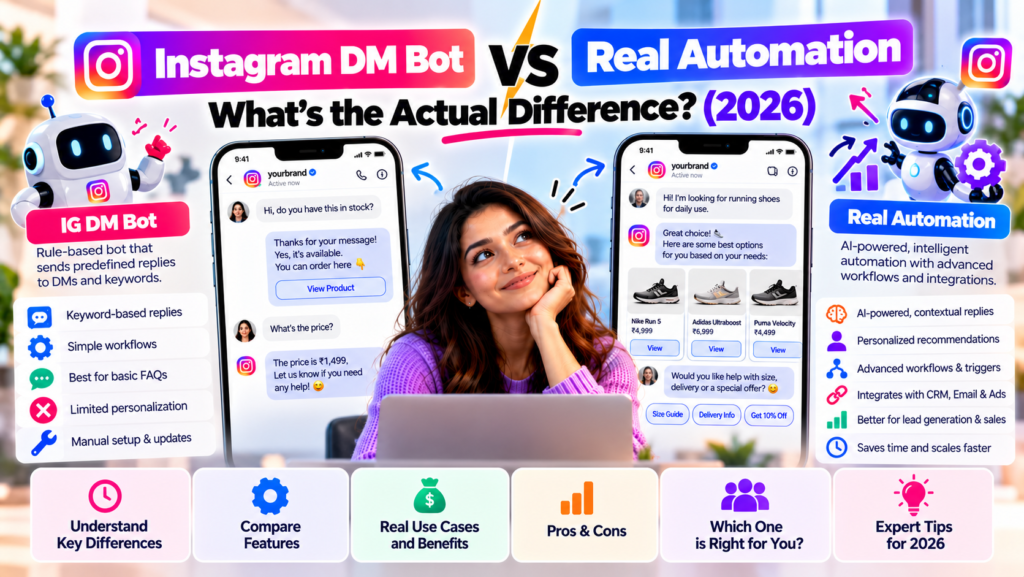
Type “instagram bot” into a search bar and the results are a mess on purpose — half the page is tools that auto-like and auto-follow strangers’ content, the other half is legitimate DM automation for businesses answering their own customers, and from the search results alone there’s no way to tell which is which. That ambiguity isn’t an accident of SEO; it’s baked into how the word “bot” gets used for two genuinely different pieces of software. One of them is safe to connect to a real business account. The other has gotten accounts restricted for years, and still does.
Same Word, Two Unrelated Products
An Instagram DM bot, in the sense that actually matters to a business, is software that replies to messages and comments sent to your own account. Someone comments “price” on your post, the bot sends them a DM with pricing. Someone messages you first, the bot replies with a welcome message and routes the conversation. It only acts on activity your own content or inbox generated.
A growth bot — also marketed as “instagram bot,” “ig bot,” “auto follower bot” — works in the opposite direction. It logs into your account and goes out and acts on other people’s content: liking posts, following accounts, sometimes leaving auto-generated comments, all under the theory that enough of that activity gets noticed and returned as a follow-back.
These aren’t two tiers of the same product. They’re built for opposite jobs, they interact with Instagram’s systems completely differently, and only one of them is something Meta’s own API actually supports.
Why Only One of These Is Built on Official Access
Instagram’s Graph API — the official, sanctioned way third-party software connects to an account — has endpoints for sending messages, reading comments, and managing your own content. It has no endpoint for “go like 200 posts” or “follow these 500 accounts automatically.” That capability simply isn’t exposed, on purpose, because Meta doesn’t want third-party software performing bulk engagement actions on other users’ content.
So a tool that promises automated liking and following isn’t using a hidden or advanced feature of the official API — it’s not using the official API at all. It’s either automating a browser to click through Instagram’s actual interface (software pretending to be a human clicking buttons, at a speed and volume no human reaches) or using reverse-engineered private endpoints Instagram didn’t intend for outside access. Both get detected. Instagram has spent years building rate-limiting and behavioral detection specifically aimed at this pattern, which is why growth-bot accounts getting action-blocked (a temporary lockout from liking, following, or commenting) or outright suspended is a routine outcome, not a rare edge case.
A DM-and-comment response bot has no need for any of that. Responding to a comment on your own post, or a message in your own inbox, is exactly the kind of action the Graph API is built to support through a normal OAuth connection — the same mechanism Meta uses for its own verified business tools.
How to Tell Which One You’re Actually Looking At
The marketing language overlaps enough that the product description alone isn’t reliable. A few concrete things aren’t ambiguous, though:
What does it claim to grow? “Grow your followers” or “get more likes automatically” is a growth bot describing outbound action on other accounts. “Never miss a DM” or “reply to comments instantly” is a response bot describing inbound action on your own account.
What does it ask permission for during signup? A response bot asks to read your comments/messages and send messages on your behalf — normal, specific OAuth scopes. A growth bot asking for broad account access with vague permissions, or asking for your password directly instead of an OAuth redirect to instagram.com, is accessing the account a different way entirely.
Does it need your activity to look like someone else’s? Growth bots often include settings for randomizing timing or varying behavior patterns “to look natural” — a tell by itself, since a legitimate response automation has nothing to disguise; it’s just answering messages as fast as they arrive.
Is pricing based on messages handled, or on follows/likes performed? Per-message or per-contact pricing points to response automation. Pricing tiers labeled by daily follow/like volume are a growth bot, full stop.
What Happens If You Use the Wrong One
A legitimate DM/comment response bot carries essentially the same risk profile as using Instagram’s own app normally — because to Instagram’s systems, it is using the app normally, just with Meta’s own sanctioned automation layer handling the replies instead of a person typing them.
A growth bot risks the account itself. The specific consequences vary — a short-term action block that stops you from liking or following anything for 24-48 hours, a longer restriction, or in cases of sustained or repeated flags, suspension — but the mechanism is consistent: Instagram’s detection is explicitly built to catch non-human engagement patterns, and growth bots exist specifically to generate non-human engagement patterns. The two are in direct conflict by design, not by bad luck.
The frustrating part for a lot of businesses: the growth-bot promise (“more followers, automatically, while you sleep”) sounds exactly like what automation should deliver, and the response-bot reality (“faster replies to people already interested in you”) sounds smaller by comparison — even though it’s the one that’s actually safe to run and the one that converts existing interest instead of chasing follower counts that don’t convert into anything.
What a Legitimate DM Bot Actually Does Day to Day
Stripped of the growth-bot confusion, a compliant Instagram DM/comment bot handles a short, specific list of jobs:
Keyword-triggered replies. A comment containing a set word or phrase fires an automatic DM — the comment-to-DM pattern most businesses actually want.
First-message welcome flows. Someone DMs you for the first time and gets an immediate, useful response instead of waiting hours for someone to notice.
Fallback routing. A message that doesn’t match any trigger gets flagged for a person to answer, rather than getting ignored or getting a reply that misses the point.
Basic conversation tagging. Marking what a conversation was actually about (pricing, support, general interest) so a growing volume of DMs stays organized instead of turning into one long undifferentiated inbox.
None of this requires acting on anyone else’s account, which is exactly why it doesn’t carry growth-bot risk.
A Concrete Example of How This Plays Out
A skincare brand running a giveaway wants two things at once: more comments on the giveaway post (entry requirement: “comment and follow to enter”) and fast replies to the resulting flood of comments. Two different tools get bought, often without the buyer clearly separating what each one is actually doing.
The response bot’s job is straightforward: someone comments “done” or tags a friend, and an automated DM confirms their entry and answers the obvious follow-up (“when do you announce winners?”). This runs entirely through the brand’s own Graph API connection, touching only comments made on the brand’s own post. No risk beyond the normal risk of running any API-connected tool.
The temptation is the second tool — something that promises to auto-follow accounts that look like past customers, or auto-like their recent posts, to “warm them up” before the giveaway, so they’re more likely to notice and enter. This is where growth-bot mechanics get introduced, often by a completely different vendor than the one running the comment replies, and often without the brand realizing the two tools carry different risk profiles. If the second tool gets flagged, the giveaway’s response automation isn’t the cause — but the account restriction hits the whole account, including the campaign that was working fine.
The practical takeaway: evaluate every tool touching the account individually, by what it actually does, rather than assuming “we’re already using automation, so this is the same risk category.”
How Growth Bots Disguise Themselves in Reviews and Marketing
A few phrases are consistent tells, because they’re doing real work to describe outbound action without saying “we follow and like other accounts automatically,” which would scare off anyone who’s researched this even briefly:
“Smart targeting” or “audience warming.” Usually means auto-following or auto-liking accounts matching a hashtag or competitor’s followers — outbound action framed as intelligence rather than bulk engagement.
“Human-like activity patterns” or “safe limits.” A legitimate response bot never needs to describe its behavior as human-like, because it only acts when a real human messages first. This language exists specifically to reassure buyers that the bot’s non-human engagement volume is being disguised well enough not to get caught — which is a tell about the mechanism, not a safety feature.
“Engagement pods” or “auto-engagement groups.” A more openly outbound variant — software coordinating accounts to like/comment on each other’s content in groups, which Instagram’s detection systems have specifically targeted for years.
None of these phrases appear on a genuine comment/DM response tool’s page, because none of them describe anything a response tool does.
Questions Worth Asking Before Connecting Any “Instagram Bot”
Does this tool act on my account, or on other people’s accounts through mine? If the honest answer involves the second half, that’s a growth bot regardless of what it’s named.
Can I see the specific OAuth permissions it’s requesting? A response bot’s permission list is short and specific. A vague, broad request is worth pausing on.
What does the pricing page actually meter? Messages/contacts handled versus follows/likes performed is the fastest way to sort the category from outside the product entirely.
What does support say happens if Instagram flags unusual activity? A legitimate provider should have a clear, confident answer about compliance. Evasiveness here is itself an answer.
AutoPubliX: Response Automation, Not a Growth Bot
AutoPubliX is built entirely in the response-automation category described above — comment and DM triggers, fallback routing, conversation tagging, connected through Instagram’s official Graph API. It has no auto-follow, auto-like, or auto-comment-on-others’-posts functionality, because that functionality isn’t what the Graph API supports and isn’t what the product is for. See the full feature breakdown or is Instagram automation safe for the complete compliance picture.
FAQs
Is “Instagram bot” always a bad sign?
No — the term gets used loosely for both legitimate DM/comment response tools and risky growth bots. The name alone doesn’t tell you which; the mechanism (acting on your account vs. acting on others’) does.
Can a DM response bot get my account banned?
Not inherently — if it connects through Instagram’s official API with proper authorization and only responds to your own comments/messages, it carries essentially the same risk as using Instagram normally
Why does Instagram allow DM automation but not follow/like automation?
Because the Graph API is designed around managing your own account’s content and conversations, not performing bulk actions on other accounts — the restriction is architectural, not a policy Meta occasionally enforces selectively.
How would I know if a tool I’m already using is a growth bot?
Check what it’s actually doing: if it’s liking, following, or commenting on posts that aren’t yours, on a schedule you didn’t manually trigger, that’s growth-bot behavior regardless of how the product describes itself.
Is it worth the risk if a growth bot genuinely grows followers faster?
Followers gained through auto-engagement on strangers’ content are typically low-intent — they followed back reflexively, not out of actual interest — and the account risk is real, not hypothetical. The trade rarely favors the growth bot even before considering the ban risk.
Does AutoPubliX do any follow/like automation at all? No — it’s built specifically around comment and DM response automation through the official API, not outbound engagement on other accounts.
Can I run a legitimate DM bot and still grow followers? Yes — just through content and genuine engagement rather than automation, which is a separate (and more durable) growth lever than anything a bot can manufacture.
What’s the fastest way to vet a new “Instagram automation” tool before connecting an account? Check the signup flow for an OAuth redirect to instagram.com instead of a password field, and check whether pricing is based on messages handled or on likes/follows performed — those two checks catch most of the distinction in under five minutes.
Want DM and comment automation that’s actually built on Instagram’s official API? See how AutoPubliX works — start your 14-day free trial, no payment today.

